
Split Vision interview: ‘We see influence as a language, not a limitation’

Split Vision is a Swedish synth-pop band that originated in the golden 1980s. Over the years, only two members remained, and for a considerable period they moved on as a cover band. A few years ago, Dan Hansson and Henric Palmqvist from Split Vision decided to return to creating their own music and, as a logical consequence, began writing original songs again. The album “Echoes Of A New Spell” clearly references their early influences, particularly Depeche Mode and their debut album “Speak & Spell”. Released by Town & Towers Records, the album strongly echoes the sound of the legendary British group. Split Vision does not attempt to hide this influence; however, they were equally determined to avoid a simple copy-and-paste approach. Dan Hansson subtly addresses this aspect in the interview. Whether they are merely copyists or not is open to debate, but “Echoes Of A New Spell” ultimately stands as well-crafted, mature Synth-Pop — confident in its roots and free of unnecessary pretense. (Courtesy by Inferno Sound Diaries)
Split Vision interview
Q: The origins of Split Vision go back to the golden 1980s, followed by a long period of inactivity, until a few years ago when you revived the project and began releasing new material. Can you tell us more about the background of Split Vision and the story leading up to this comeback?
Dan: Split Vision was originally formed in the mid-to-late 1980s by four friends who shared a strong fascination for synthesizers, melody, and the Electronic sound that was emerging at the time. It was a very natural and creative phase — experimenting, recording, and learning together, without any clear roadmap or long-term ambition. As the years went on, two of the members gradually moved on to studies and other life commitments. There was no conflict or dramatic breakup, but the band slowly lost momentum. What remained was the core partnership between Dan and Henric, and perhaps more importantly, a shared love for music that never disappeared.

Even though Split Vision as a project faded into the background, we, Dan and Henric continued making music together in different ways. For many years, we played covers at private events — weddings, sports gatherings, and corporate parties — which kept the joy of performing alive and strengthened our musical chemistry. In hindsight, those years were an informal but valuable education in musicianship, dynamics, and playing for an audience.
The actual comeback happened much later and very organically. Revisiting old ideas and demos eventually led to new material, and it became clear that Split Vision still had a voice — now shaped by experience, time, and perspective. Rather than trying to recreate the past, the revived project feels like a continuation, where the emotional core remains the same but the expression is more focused and mature.
Q: I’ve read that this Split Vision album was strongly inspired — synthesizers included — by Depeche Mode’s debut album “Speak & Spell”. What drew you so deeply to that record, and how did that influence translate into your own songwriting?
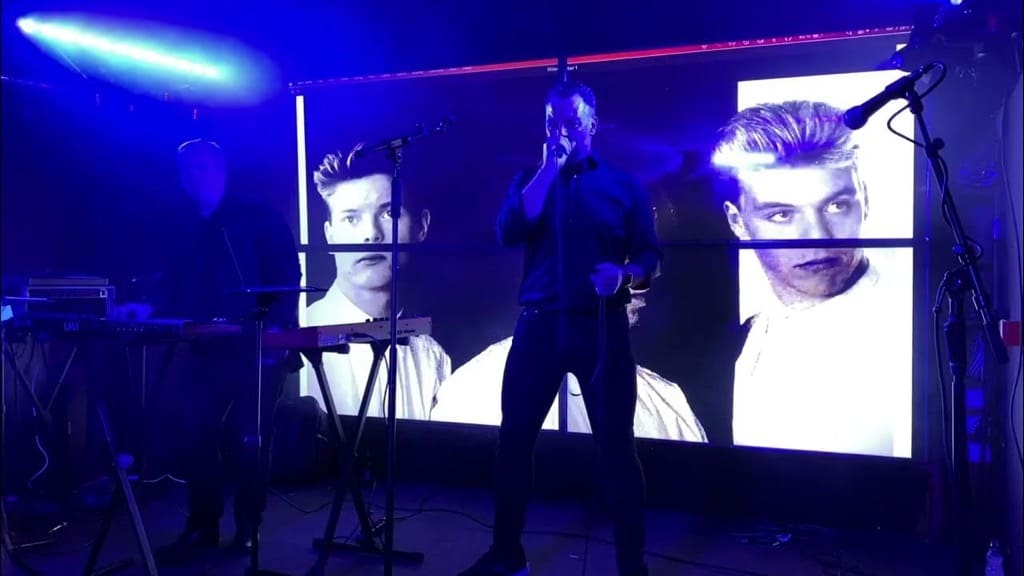
Dan: Honestly, what drew us in most were the actual sounds those early synthesizers produced. Monophonic, limited by today’s standards — but now considered truly classic. The way Depeche Mode used those machines on “Speak & Spell” was incredibly smart and deeply melodic. Despite the technical limitations, the songs were strong, memorable, and emotionally direct. That became the core inspiration for us. We wanted to work with the same kind of simplicity — to deliberately use similar synthesizers in all their limitations and see what could be achieved if we had access to the same type of sonic toolbox Depeche Mode had at the time.
The idea wasn’t to recreate their sound, but to explore what we could do within those boundaries. In a way, the simplicity of the synthesizers set a ceiling — a clear framework for what was possible. And instead of seeing that as a restriction, we embraced it as a creative engine. Working within those limits forced us to focus on melody, songwriting, and atmosphere. The result is the album we ended up making — shaped by classic machines, classic sounds, and filtered through our own perspective and identity as Split Vision.
Q: Given the strong Depeche Mode influence, do you ever worry about being perceived as ‘just another’ band or copyist in that vein? Where does originality come into play for you, and what do you feel makes Split Vision stand apart from similar projects?
Dan: We understand that comparison is inevitable, especially when you openly acknowledge your influences. But for us, the goal was never to hide where we come from — quite the opposite. We see influence as a language, not a limitation. What matters is what you say with it. Originality, in our case, doesn’t come from trying to invent a new sound from scratch, but from perspective, intent, and experience. We’re not approaching this music as teenagers chasing a trend, but as musicians with decades of life, listening, and playing behind us. That inevitably shapes the songwriting — lyrically, emotionally, and structurally.
What we feel sets Split Vision apart is that this isn’t nostalgia or cosplay. It’s a conscious, focused project built on limitations, melody, and emotional honesty. The references are clear, but the songs reflect who we are now, not who we were then. In that sense, the influence becomes a foundation rather than a blueprint. If anything, we believe that being transparent about our inspirations allows the music to stand more confidently on its own. The moment you stop pretending to be original and instead focus on being sincere, that’s where originality actually begins.
Q: When thinking about the 1980s, analog synthesizers immediately come to mind — often complex, yet highly distinctive machines. Today, however, software synths and even AI tools are increasingly used to recreate those sounds. How do you feel about this shift, and what kind of equipment do you work with in your studio?
Dan: It’s true that today you can make songwriting and music production a fully automated process if you want to. But that’s not what motivates us. We often compare it to solving a crossword puzzle. You can already feed a crossword into AI and get a perfectly solved version back — but where’s the fun in that? Where’s the challenge? We solve crosswords because we want to see if we can. Music works the same way for us.
When it comes to equipment, we’re not dogmatic. We do use software synthesizers, partly because original vintage machines are incredibly hard to find today without taking out a small bank loan. Using modern tools to recreate classic sounds doesn’t feel wrong to us — it allows us to access that sonic character and work within the same kind of limitations that shaped the music we love.
But the core always lies in the songwriting. The same goes for lyrics. We’re not opposed to using tools like word lists, synonym dictionaries, or rhyme references — those are just aids. But letting an AI write an entire lyric for us removes the most rewarding part of the process. It’s the doing that matters.
At the heart of Split Vision, this is still a hobby driven by curiosity and joy. We genuinely enjoy spending time together, recording, experimenting, and exploring new musical paths. There’s no ambition to mass-produce songs just because it’s technically possible. We prefer making fewer tracks, but making them ourselves — because that’s where the fun is, and that’s why we’ll keep doing this for a long time.
Q: Can you walk us through the different stages of bringing this Split Vision album to its final form, and tell us what “Echoes Of A New Spell” is about on a lyrical level?
Dan: The process of bringing the album together doesn’t really follow a fixed formula — it can start in many different places. Sometimes it begins with a simple but satisfying arpeggio or bass line, other times with a single lyric line that captures a feeling or an idea we want to explore. That small spark is usually enough to get us going.
From there, we start building a kind of framework around it. We quickly sketch layers — drum patterns, pads, strings, textures — and let the song take shape organically. Vocals are added once the atmosphere feels right, and during the mixing phase we really listen closely: what’s missing, what should be removed, what needs to be strengthened or simplified. We work very much in layers, refining rather than piling things on endlessly.
Ironically, with today’s almost unlimited access to plugins and tools, we often find it helpful to impose our own limitations. For this album, that was very intentional. Limiting ourselves forces us to carve out what truly matters within a defined space. In many ways, it mirrors how we worked back in the 1980s — restricted by budget and availability, which made us inventive, curious, and open to alternative solutions. That mindset has stayed with us.
On a lyrical level, “Echoes Of A New Spell” reflects themes of change, repetition, and renewal. The songs deal with patterns we recognize in ourselves and in the world around us — how history, emotions, and choices tend to echo, yet always carry the potential to transform into something new. For us, music and lyrics are inseparable. We always aim for a complete, coherent listening experience, where every element has meaning and serves the song as a whole.
Q: You clearly draw a lot of inspiration from the past, but how do you view the future, and what plans do you have moving forward with Split Vision?
Dan: While our roots are clearly connected to the past, we don’t see Split Vision as a retrospective project. For us, the past is more of a reference point than a destination. It gives us a language and a framework, but what we do with it is very much about the present — and the future.
Moving forward, we want to keep working in the same spirit that brought this album to life: curiosity, limitations as a creative tool, and a genuine enjoyment of the process. We’re not in a rush, and we’re not chasing trends. New material will come when it feels meaningful, not because there’s a schedule to follow. We also want to continue exploring how our sound can evolve without losing its core identity — refining rather than reinventing. Live performances, selective releases, and new ideas are all on the table, but always with quality and intention as the guiding principles.
Ultimately, the plan is simple: to keep creating music together for as long as it remains inspiring and fun. As long as that spark is there, Split Vision will keep moving forward — one song at a time.

I have been working for over 30 years with Side-line as the main reviewer. My taste is eclectic, uncoventional and I prefer to look for the pearls, even if the bands are completely unknown, thus staying loyal to the Side-Line philosophy of nurturing new talents.
Since you’re here …
… we have a small favour to ask. More people are reading Side-Line Magazine than ever but advertising revenues across the media are falling fast. Unlike many news organisations, we haven’t put up a paywall – we want to keep our journalism as open as we can - and we refuse to add annoying advertising. So you can see why we need to ask for your help.
Side-Line’s independent journalism takes a lot of time, money and hard work to produce. But we do it because we want to push the artists we like and who are equally fighting to survive.
If everyone who reads our reporting, who likes it, helps fund it, our future would be much more secure. For as little as 5 US$, you can support Side-Line Magazine – and it only takes a minute. Thank you.
The donations are safely powered by Paypal.


